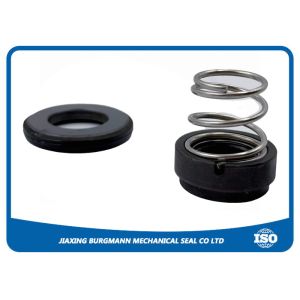
Single Big Spring Water Pump Seal With Solid Sic Less Leak
This single big spring water pump seal utilizes a robust,
heavy-duty helical spring to provide a consistent axial closing
force on the seal faces. The primary sealing rings are constructed
from monolithic, solid silicon carbide (SiC) on both the rotating
and stationary faces. This material combination offers exceptional
resistance to abrasive particles, providing superior wear
characteristics and extended service life in harsh water
applications, including those with suspended solids. The simple,
large-spring design enhances stability and reduces the risk of
clogging in dirty water environments. The exceptional hardness and
low friction coefficient of the solid SiC faces minimize heat
generation and wear, directly resulting in a significantly lower
leak rate compared to seals with carbon/graphite or reaction-bonded
SiC faces. This design is engineered for reliability in general
industrial water, cooling, and low-pressure transfer pumps.
Features
- For plain shafts
- Single seal
- Unbalanced
- Conical spring rotating
- Dependent on direction of rotation
Advantages
- Economical seal solution
- No damage of the shaft by set screws
- Short installation length possible (G16)
Operating range
Temperature:
–20 °C ~ 140 °C (–4 °F ~ 355 °F)
Pressure:
up to 145 psi(g)/10 bar(g)
Recommended applications
- Water and waste water technology
- Building services engineering
- Water pumps
- Heating circulation pumps
Materials
Seal face:
Carbon graphite resin impregnated
Seat G9:
Silicon carbide, Special cast CrMo steel, Aluminium oxide
Product variants
M2
Rotating unit M2 with seat G4 or G16 (shorter installation length)
Seal face: Carbon graphite resin impregnated
Seat G4: Silicon carbide, Special cast CrMo steel
Seat G16: Silicon carbide, Special cast CrMo steel, Aluminium oxide
M2N4
Rotating unit M2 with seat G6
Seal face: Carbon graphite resin impregnated
Seat G6: Silicon carbide, Special cast CrMo steel

Frequently Asked Questions
Q1: What is the key material advantage of solid silicon carbide
(SiC) seal faces in abrasive water applications?
A1: Solid SiC possesses extreme hardness (Knoop 2600 kg/mm²) and
high thermal conductivity, which provides exceptional resistance to
abrasive wear. This minimizes face erosion and maintains face
flatness, directly leading to a lower and more stable leak rate
over the seal's lifespan compared to softer materials like carbon
graphite.
Q2: How does the single spring design impact maintenance and
serviceability?
A2: The simplicity of the single large spring design offers
improved resistance to clogging from silt or debris in raw water.
It also simplifies inspection and handling during maintenance
procedures, as there are no multiple small springs to corrode or
lose.
Q3: What is the primary limitation of a single big spring design
regarding operational speed?
A3: The primary limitation is centrifugal unweighting. At high
rotational speeds, centrifugal forces can act on the large spring,
reducing its effective closing force on the seal faces. This makes
the design generally unsuitable for very high-speed applications,
where a multi-spring design is preferred.
Q4: Why is this seal type particularly suited for raw water and
cooling water services?
A4: Its suitability stems from the combination of the
clog-resistant single spring and the highly abrasion-resistant
solid SiC faces. This configuration reliably handles suspended
solids without the failure modes associated with multi-spring seals
(clogging) or carbon faces (erosive wear).